
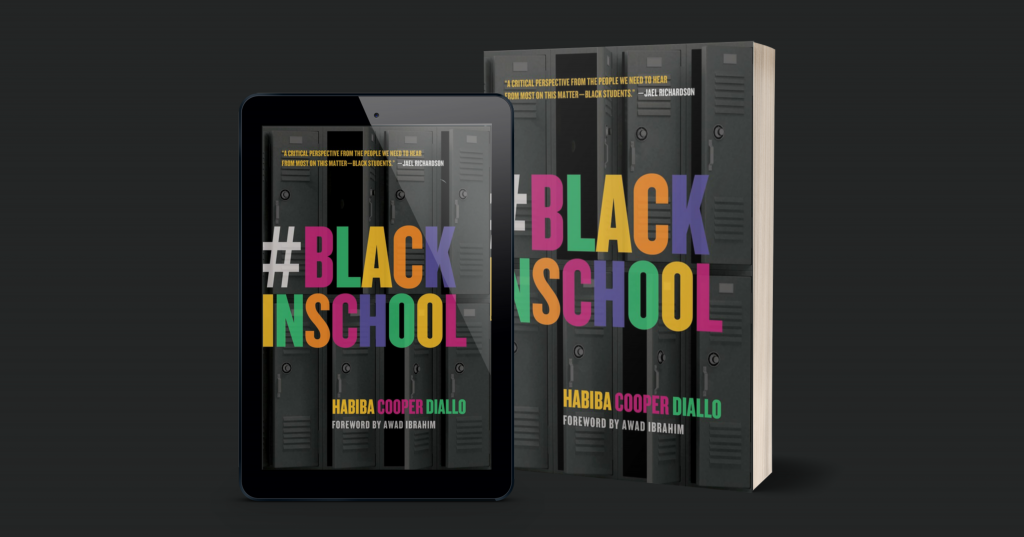
While we talk about the racial education attainment gap and how affects a student’s prospects, we don’t often talk about the specific ways in which anti-Blackness operates in the education system. A much-needed exploration, examination, and exposé on this issue, #BlackInSchool does that work, providing a template for how to talk about anti-Blackness in other systems. As Habiba Cooper Diallo writes in her introduction, “the title #BlackInSchool could easily be expanded to include: #TravellingWhileBlack, or #ShoppingWhileBlack, or #WalkingWhile Black.”
Written by Diallo during her final two years of high school in Halifax and published by the University of Regina Press, this is a makeshift diary drawn from a wealth of personal journal entries documenting the experience of being Black in a Canadian school. Each entry is relatively short, beginning with a quote from a well-known Black public figure and focused on real-life anecdotes of micro and macro aggression. From being harassed by teachers in the hallway who assume you are up to no good, to constantly checking the narrative of Black inferiority that rears its ugly head in every subject, #BlackInSchool sheds light on all the ingenious ways in which anti-Blackness contorts itself to remain viable in the education system.
“Written by Diallo during her final two years of high school in Halifax and published by the University of Regina Press, this is a makeshift diary drawn from a wealth of personal journal entries about the experience of being Black in a Canadian school.”
A blend of anecdote, analysis, and academia, #BlackInSchool is a formal triumph that brings together various forms of storytelling to create a dynamic book. Though the nature of discrete diary entries may feel incoherent, its main strength, however, is not in the regurgitation of the facts and figures many will already know. It is in how these are personalised through the intimacy of the diary form. We are hearing the story from the horse’s mouth, and a diary from a student documenting exactly how the educational system’s anti-Blackness targets her daily is more powerful than a cold report could ever be. While Diallo says that it is aimed at students and teachers, #BlackInSchool is a loud and fiercely vital document that moves forward the conversation about anti-Blackness in the educational system.
By Jane Link
JANE LINK is a master’s student and an editor for Split Lip Magazine, The Publishing Post, and her own beloved bigblackbooks. When not trying to land her first job in publishing, Jane loves to read historical fiction, self-help, and everything by Black voices. She dreams of one day setting up an independent dedicated to publishing those voices. You can find her on Twitter @verybookishjane.
HABIBA COOPER DIALLO is the founder of the Women’s Health Organization International (WHOI). She has been building awareness about obstetric fistula since the age of 12. In 2015, she published a book for your adults called, Yeshialem Learns About Fistula. She is an award-winning writer, public speaker and women’s health advocate. The Federal Government of Canada recognized her as an outstanding Canadian woman in 2019. She was also invited by former Minister of International Development, the Honourable Maryam Monsef (currently Minister for Women and Gender Equality and Rural Economic Development) to speak on a panel about ways to advance gender equality in Canada. You can find her on Twitter and on her website.
 #BlackInSchool by Habiba Cooper Diallo
Published by University of Regina Press on 4 September 2021
Genres: #ownvoices, African, Afro-Caribbean, Debut, Non-fiction, YA
Pages: 122
Format: Paperback
Buy on Waterstones
Goodreads

The prevalence of anti-Black racism and its many faces, from racial profiling to police brutality, in North America is indisputable. How do we stop racist ideas and violence if the very foundation of our society is built upon white supremacy? How do we end systemic racism if the majority do not experience it or question its existence? Do our schools instill children with the ideals of equality and tolerance, or do they reinforce differences and teach children of colour that they don't belong? #BlackInSchool is Habiba Cooper Diallo's high school journal, in which she documents, processes, and resists the systemic racism, microaggressions, stereotypes, and outright racism she experienced in Canada's education system. Powerful and eye-opening, Cooper Diallo illustrates how our schools reinforce rather than erode racism: the handcuffing and frisking of students of colour by police at school, one-dimensional, tokenistic curricula of Black people, and the constant barrage of overt racism from students and staff alike. She shows how systemic racism works, how it alienates and seeks to destroys a child's sense of self. She shows how our institutions work to erase the lived experiences of Black youth and tries to erase Black youth themselves. Cooper Diallo's words will resonate with some, but should shock, appall, and animate a great many more into action towards a society that is truly equitable for all.


